Showing posts with label IELTS. Show all posts

Tuesday, 29 January 2019

Give your New Year’s Goals a boost!


Goodbye December 2018, welcome February 2019.
Who said that new year’s resolutions must start in January? If procrastination is something you want to get rid of this year, then February sounds great (you know, baby steps).

We are all capable of coming up with new year’s resolutions in January but let’s be honest, after the Holidays stress, thinking about new projects isn’t at the top of our list of priorities.
Good thing is that we have another 11 months to get back on tracks! Sure, the first month is filled with good intentions, from the Veganuary, to the Dry January challenge, if you decide to follow the newest online trends. But your New Year’s resolution doesn’t need to be advertised, posted, tweeted or shared to be effective.


Taking up a new hobby, subscribing to the gym, drinking more water, bullet journaling…you name it!

As far as English is concerned, though, allow us to give you some ideas.
Independently on what your needs are, at ELA we can create tailored courses accordingly:

Are you considering enrolling into University but have some doubts about your English Level? Don’t have the chance to travel? Give our Distance Learning IELTS a go!
Our 4-week online distance learning course allows students from all over the world to reach their IELTS goal through an immersive experience, while comfortably sitting at home or at the office.


Do you work in the Tourism and Hospitality field? Are you a manager or a receptionist working in the Tourism and Hospitality sector? Would you like to step up your game and aim at a higher job position? We offer a wide range of courses approved by the Confederation of Tourism and Hospitality.


Would you like to be employed in the education system? Would you like your teaching experience to be recognized and used to enhance your career opportunities? Enrol now in our Trinity CertTESOL course. Little time on your hands? Don’t worry: we also have part-time lessons! Our Director of Studies will answer your questions at dos@elacademy.co.uk.


You’re new in town and fear to be judged for how you speak English? Difficult for you to attend an English course in the morning? We got you covered with our Free English Lessons. You’ll only have to commit for a couple of afternoon hours, from February (Monday to Friday), for a month. What are you waiting for? Contact us to learn more.

Remember that you always have time to grow as a person and in your profession. Whatever English level you start from, it will always be a powerful weapon to carry.
And since we are approaching the world’s most famous romantic love’s celebration, gift your partner with an English course by taking advantage of our exclusive 25% discount! Contact us now!


Wednesday, 8 November 2017

Increase your reading speed with a top-down approach

Time is your enemy in an exam.  The  Cambridge ESOL and IELTS reading papers both require candidates to complete many lengthy tasks in a severely limited time-period.  How can we make the most of our precious time?


A top-down approach is one technique that can be used to increase your ability to gist-read (reading for general understanding) as it allows you to make use of your pre-existing knowledge of a topic. 

Let’s look at a newspaper article.  Newspapers are wonderful sources of authentic content and should be read regularly to help increase vocabulary.  Before we even open the newspaper, we can make some assumptions about the story we are going to read:
·      *    it will have a clear headline
·       *   it will probably have a sub-heading
·       *  the opening paragraph will probably be an overview of what the story is going to be about
·        * there might be a picture it may be written entirely in the passive voice

Opening a newspaper, we may read a headline like:
Computer Firm’s Share Price Drops


As we read the headline, our mind is automatically associating the words we have previously absorbed on the subject.  It happens instantaneously.

Now that we have an idea of what the story could be about, we read the opening paragraph.  This should affirm our prediction and allow us to read the whole story relatively quickly as we combine the words on the page with the knowledge we have activated.

This means that if you have an idea where the story came from, it can help you predict something about the content.  This in turn allows you to train your mind into linking contexts with your own knowledge.


The message is clear and simple. Before you start reading, take a moment to make predictions about the text and allow your brain to start making connections. The time it saves you could be invaluable.

Contact us to see how we can help. 

info@elacademy.co.uk +44 (0)131 226 6182 

Find us on FacebookTwitter and Instagram

Wednesday, 18 October 2017

IELTS Top Tips: Part 2

Following on from our IELTS Top Tips: Part 1 covering listening and reading, this week we bring you our guide to the productive sections of the exam: speaking and writing

Speaking

  • Build a library
Collect your favourite phrasal verbs/idioms and make sure they can be used in a variety of contexts: e.g. describing likes and dislikes. Remember, you have a limited time to impress and it is vital you show off your knowledge

  • Start your preparation early
Don’t leave speaking preparation till the end of the course. Start using your favourite expressions soon and try to use them every time you practise. The aim is for you to be able to produce a range of grammar and vocabulary that will impress the examiner and not seem forced.

  • Use your voice
Don’t make the mistake of thinking pronunciation is only about vowel and consonant sounds. While accurate production is important you should also remember to change the speed and pitch of your voice to add emphasise, and enhance meaning.


Writing

  • What’s true for speaking is true for writing
Like speaking, start your writing preparation early aiming to collect advanced grammar and vocabulary that you will be able to use in part 2. One possibility is to prepare a model for part 2 into which you can insert the details of your particular topic.

  • Be practical in part 1
Remember that while part 2 is literary, part 1 is more scientific. You do not need beautiful vocabulary or a wide range of advanced structures to succeed here. Rather, ask yourself if a reader could recreate the graph/diagram/chart from your description. Focus on accuracy and detail.

  • Tactics, tactics, tactics

You should be able to do well in writing as it is so tactical. Learn the rules and follow them. Pay close attention to the word count and most importantly: ANSWER THE QUESTION and resist the temptation to alter it to suit your interests or knowledge.


Contact us to see how we can help. 

info@elacademy.co.uk +44 (0)131 226 6182 

Find us on FacebookTwitter and Instagram

Thursday, 12 October 2017

IELTS Top Tips: Part 1


We all know what an important exam IELTS is, and many of our students at ELA-Edinburgh come to us with a target score for entrance to a British university.

For all IELTS students, here are our top tips for every section of the exam!

This week we tackle the receptive skills: reading and listening

Reading
  • Read the questions carefully
There are many different task types in the reading section so don’t assume you know what to do!

  • Underline the words that gave you the answer
Always check your answers before transferring them to the answer sheet. When you do this, ask yourself why you chose that answer. Look at the words you underlined and check you agree.

  • Only take information from the text
It’s tempting to allow outside knowledge to affect your answer but remember the only relevant information is that in the text.


Listening

  • Focus at all time
Remember listening is active and requires 100% concentration. It is hard work but switching off will cost you valuable points.

  • Predict
Use the time you get before the exercises well. It is vital, especially in gap fill exercises, that you guess what could be in the gap.

  • Keep calm
The exam writers are not your friends. They know you’re nervous and likely to put the first viable answer you hear. If you know the answer is a number, it highly probable there will be two or three numbers designed to confuse you.

Check the blog next week for our tips on the productive skills: writing and speaking

Contact us to see how we can help. 

info@elacademy.co.uk +44 (0)131 226 6182 

Find us on FacebookTwitter and Instagram

Monday, 28 August 2017

New Evening and Weekend English Courses at ELA-Edinburgh


ELA-Edinburgh is excited to announce its new evening and weekend English courses, for all those busy people unable to study during normal class hours. If you want to improve your English for confidence, your studies, or for the work place this is the perfect opportunity to take your English language skills further.

Until June 2018, we are offering affordable part time classes with experienced English language teachers during weekday evenings and on Saturdays. With our school based in the heart of Edinburgh city centre, it’s an ideal location to find some time to fit in English lessons.


“ELA-Edinburgh is by far the most enriching experience I have ever had in terms of language studies. In this school, you will learn a lot not only grammar, useful English expressions, but also about Scottish culture. The staff is very welcoming and they always make sure you receive the best attention. Despite all the stereotypes you hear on the grapevine, Edinburgh is the best city in which you can learn English and what a better option than learning or improving your English at ELA-Edinburgh”
Raul Melendez (ELA-Student, October 2016-March 2017)
Whether it is an English course in General English, Business English, Cambridge Exam Preparation or IELTS Exam Preparation, ELA-Edinburgh has something for everybody wanting to brush up and improve their skills.

We are offering 
Evening courses Monday to Thursday 6pm - 8pm or 
Saturday morning's at 10am - 2.30pm. 

Visit ELA-Edinburgh to find out more 
Or contact us by email dos@elacademy.co.uk or phone 0131 226 6182

Follow us on Facebook, Twitter and Instagram

Monday, 26 September 2016

Introducing IELTS

There can be no doubt; IELTS has largely cornered the market for universities and visas. It’s a safe bet that if you want to study in the UK, or move here from the outside the EU, IELTS will help you on your way.
IELTS is recognised at universities and governments all over the world. In the UK it is one of only two exams recognised by UK Visas and Immigration. Students; IELTS will help you get your tier 4 visa to come to the UK and enjoy our fantastic colleges and universities. Remember that ELA is always happy to arrange short term Visa and TIER 4 Visa letters for candidates who qualify for them!
Clearly IELTS is more important than ever. So what is it????
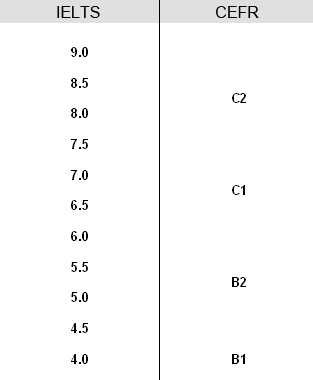
Unlike most other exams IELTS can be taken by students of various levels, the exam is designed to evaluate a range of abilities. As such there is no pass or fail; instead there are bands from 1.0 to 9.0, with half scores also possible. You can see how it compares with the Common European Framework below:
ielts-scores
IELTS tests the four skills of reading, listening, writing and speaking. Most candidates are relieved to find there is no grammar section! You also have the luxury of choosing from General or Academic IELTS, though the vast majority of people take the academic exam as it’s what universities and colleges want. Although the language in IELTS reading and writing can be quite formal there is plenty of room to produce phrasal verbs and idioms in the speaking! Just remember not to beat around the bush!!!
At ELA we have had a decade of teaching IELTS to highly motivated students. We have had the pleasure of seeing countless students from all backgrounds achieve the score they needed to progress in their academic or professional lives. As teachers this gives us the kind of job satisfaction that keeps us motivated!
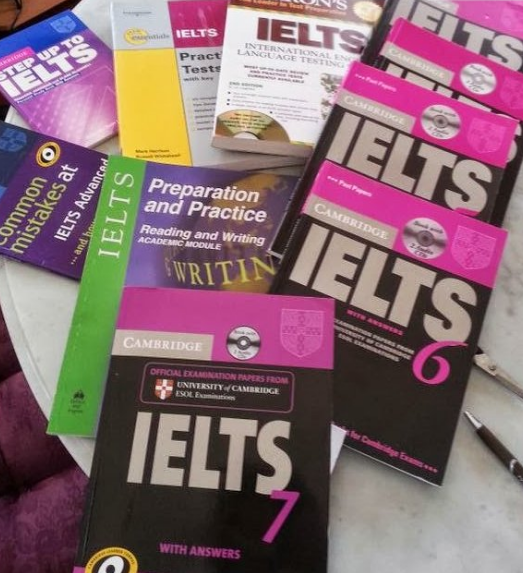
We have a library stuffed with IELTS materials
ielts-materials
  • Various different course books
  • Official IELTS practice tests
  • Listening materials
  • Interactive smartboards in classrooms
  • Writing and speaking guides
  • Vocabulary books
All of these resources are put to good use by our experienced teachers to make sure you’re given support in the areas you need. At ELA you can study for five hours a day. In the morning (9-1230) you’ll focus on expanding your language skills as well as academic English. In the afternoon you can produce the language you’ve learnt in our IELTS course (1330-1530.) Longer-term students will have regular tutorials with our director of studies, who will keep an objective eye on your progress.
If you’re ready to take on the challenge of IELTS then we’re ready to help. Contact us at dos@elacademy.co.uk to get started!