Showing posts with label vocabulary. Show all posts

Thursday, 18 January 2018

Using Film in the Classroom

Here at ELA, we believe that variety is the spice of life. Learning, like all things,  can get boring if you do the same thing all the time. That's just one of the many reasons why videos are an important part of our eclectic approach. Here are some of the other factors that can make videos such a useful tool in the classroom.


An introduction to authentic material

We want our students to be exposed to as much English language culture as possible. By watching TV programmes and films in the original English version, learners are likely to pick up new expressions and hear a wider variety of accents. However, this can be intimidating and many students wrongly think it is too difficult for them. Introducing shorter, more manageable videos in a supportive classroom atmosphere can persuade students they are capable of watching longer videos at home.

For the Teacher

From a teacher's perspective videos can be tailored to every level from beginner to advanced. We can choose what grammar points to raise and what vocabulary to highlight as long as we plan in advance and watch the video ahead of the lesson! There are also lots of fantastic websites to help you incorporate film into your lessons.

Share critically acclaimed short-films with your students


For the student

Students often find videos a welcome change from the textbook and can understand vocabulary more easily as the video provides a natural context. Videos can also inspire incredibly student-centred activities where learners take their mobile phones out of the classroom to create their own videos.
One of ELA's Interactive smartboards

Technology plays a vital role in any modern ELT classroom. Our school is lucky to boast two interactive smartboards and internet access in every classroom. There really is no excuse not to utilise film!

Tuesday, 9 January 2018

A New Year's Resolution: Use Grammar Accurately to talk about the Future

Welcome 2018!  Welcome our annual promises about the year ahead!  It's the time of year to make resolutions about what we will do (or are going to do) in the next twelve months. But, as we all know, choosing the right tense to talk about the future is not always easy.


Popular resolutions
This week the teachers and students at ELA-Edinburgh have been making their own resolutions. Three of the most popular were
   * Cook a new recipe everyday
 Spend less money
  *Walk to school

The problem is, what tense should we use to express these promises?


‘Will’
Most textbooks will tell you to use will (or future simple) for promises. If you somebody tells you a secret you might promise “Don’t worry, I won’t tell anyone.” As resolutions are a type of promise it can make sense to say “I will walk to school every day”.

‘Going to’
However, the most natural way to talk about resolutions is with ‘going to’. We use this tense to talk about plans, things we have decided to do. This means that “I’m going spend less money” sounds a lot more serious than “I’ll spend less money.”


What are you going to do in 2018? Tweet us @E_L_Academy to tell us your New Year’s Resolutions!!

Friday, 22 December 2017

Christmas Vocabulary Guide

Earlier in 2017 we brought you tips on learning vocabulary. Now, to help you enjoy/survive Christmas, we present ELA-Edinburgh's top Christmas vocabulary.

Re-gift

Have you ever received a Christmas present you didn't enjoy? Did you think about giving that same present to somebody else? This is re-gifting and, for many people, it is not socially acceptable.


Hogmanay /hɒɡməneɪ/

Don't come to Scotland without knowing about Hogmanay. It's our name for December 31st and all the celebrations that go with it. We take Hogmanay take very seriously. The rest of the UK goes back to work on January 2nd but not in Scotland. We need an extra day to recover.


Stocking Stuffers

In the UK, most children receive a stocking full of relatively small presents. Stocking stuffer has become a synonym for small, inexpensive presents that can fit into the stocking. But remember, even stocking stuffers can't be re-gifted!


Scrooge

Scrooge is one of the most famous characters from Charles Dickens, the author that had such a huge influence on British Christmas traditions. It's such a powerful character that to be called 'a scrooge' is a big insult. Scrooges are mean, miserable and don't enjoy Christmas.


Togetherness

The opposite of scrooge in many ways. Togetherness is the feeling of community and family that many people in the UK feel around Christmas. For lots of British people, it's a time when being together with friends and family is especially important.

Happy Christmas from all the team at ELA-Edinburgh!

Thursday, 12 October 2017

IELTS Top Tips: Part 1


We all know what an important exam IELTS is, and many of our students at ELA-Edinburgh come to us with a target score for entrance to a British university.

For all IELTS students, here are our top tips for every section of the exam!

This week we tackle the receptive skills: reading and listening

Reading
  • Read the questions carefully
There are many different task types in the reading section so don’t assume you know what to do!

  • Underline the words that gave you the answer
Always check your answers before transferring them to the answer sheet. When you do this, ask yourself why you chose that answer. Look at the words you underlined and check you agree.

  • Only take information from the text
It’s tempting to allow outside knowledge to affect your answer but remember the only relevant information is that in the text.


Listening

  • Focus at all time
Remember listening is active and requires 100% concentration. It is hard work but switching off will cost you valuable points.

  • Predict
Use the time you get before the exercises well. It is vital, especially in gap fill exercises, that you guess what could be in the gap.

  • Keep calm
The exam writers are not your friends. They know you’re nervous and likely to put the first viable answer you hear. If you know the answer is a number, it highly probable there will be two or three numbers designed to confuse you.

Check the blog next week for our tips on the productive skills: writing and speaking

Contact us to see how we can help. 

info@elacademy.co.uk +44 (0)131 226 6182 

Find us on FacebookTwitter and Instagram

Thursday, 17 August 2017

Theatre Meets Academia at ELA-Edinburgh

As part of a combined English language course, a group of 14 Chinese students from Beijing have worked on an act of the play, The Curious Savage. Working alongside ELA-Edinburgh teachers and a drama workshop facilitator, their one hour daily classes were dedicated to learning the techniques and language associated with stage theatre and performing drama. Performance skills were included in our workshops, with each rehearsal beginning with a physical warm up using the whole body, channeling energy and working their vocal chords in anticipation of performing in a large space.

The Curious Savage, by John Patrick, set and premiered in 1950’s America, takes place in a residential home called 'The Cloisters', a lodgings to several of the play’s characters. Mrs Ethel P. Savage, the main protagonist, is taken to the home by her step-children. They think she has lost her mind, having used her late husband’s money to set up a memorial trust fund, rather than distribute the wealth between the family.


The act our students worked on depicts the arrival of Mrs Savage to an already established group of residents at The Cloisters, showing their initial encounters. We also meet her family, whom she clearly dislikes, and the ever-patient and caring staff who work at The Cloisters.

In the first week of classes, students developed their theatre vocabulary, and worked on the language of the text. At times, this was a challenge, as its context is in colloquial 1950’s America.

The following classes were dedicated to performance techniques and practising short scenes. We used a text excerpt which allowed the students to work in small groups, rotating the roles they played and let them really get to grips with reading aloud from scripts. From this group work, the play was cast, and students were given their parts. Work continued, including ‘blocking scenes’, where we collaborated in working out where set items will be positioned, where characters are on the stage when they deliver their lines, and general movement of the individuals on stage.

After five weeks of morning English classes, afternoon drama classes, rehearsals, poetry and singing, the students have a challenge ahead as they take all of this back to China to perform. The theatre practice will continue, with their lines and set design, without the help of our teachers.

They will be required to learn their lines and work together to stage the piece without the help of ELA-Edinburgh staff. The final sessions with the students were focused on ensuring that each student felt confident in their own part, and with grasping vocabulary and pronunciation.

We wish them all the best!


For more information about our school, check out our website ELA-Edinburgh

Follow us on Facebook, Twitter and Instagram

Monday, 26 September 2016

Introducing IELTS

There can be no doubt; IELTS has largely cornered the market for universities and visas. It’s a safe bet that if you want to study in the UK, or move here from the outside the EU, IELTS will help you on your way.
IELTS is recognised at universities and governments all over the world. In the UK it is one of only two exams recognised by UK Visas and Immigration. Students; IELTS will help you get your tier 4 visa to come to the UK and enjoy our fantastic colleges and universities. Remember that ELA is always happy to arrange short term Visa and TIER 4 Visa letters for candidates who qualify for them!
Clearly IELTS is more important than ever. So what is it????
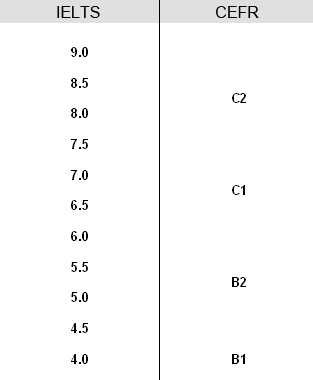
Unlike most other exams IELTS can be taken by students of various levels, the exam is designed to evaluate a range of abilities. As such there is no pass or fail; instead there are bands from 1.0 to 9.0, with half scores also possible. You can see how it compares with the Common European Framework below:
ielts-scores
IELTS tests the four skills of reading, listening, writing and speaking. Most candidates are relieved to find there is no grammar section! You also have the luxury of choosing from General or Academic IELTS, though the vast majority of people take the academic exam as it’s what universities and colleges want. Although the language in IELTS reading and writing can be quite formal there is plenty of room to produce phrasal verbs and idioms in the speaking! Just remember not to beat around the bush!!!
At ELA we have had a decade of teaching IELTS to highly motivated students. We have had the pleasure of seeing countless students from all backgrounds achieve the score they needed to progress in their academic or professional lives. As teachers this gives us the kind of job satisfaction that keeps us motivated!
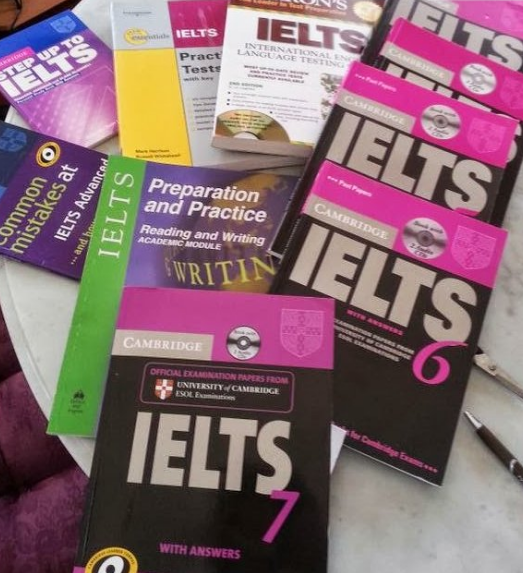
We have a library stuffed with IELTS materials
ielts-materials
  • Various different course books
  • Official IELTS practice tests
  • Listening materials
  • Interactive smartboards in classrooms
  • Writing and speaking guides
  • Vocabulary books
All of these resources are put to good use by our experienced teachers to make sure you’re given support in the areas you need. At ELA you can study for five hours a day. In the morning (9-1230) you’ll focus on expanding your language skills as well as academic English. In the afternoon you can produce the language you’ve learnt in our IELTS course (1330-1530.) Longer-term students will have regular tutorials with our director of studies, who will keep an objective eye on your progress.
If you’re ready to take on the challenge of IELTS then we’re ready to help. Contact us at dos@elacademy.co.uk to get started!